
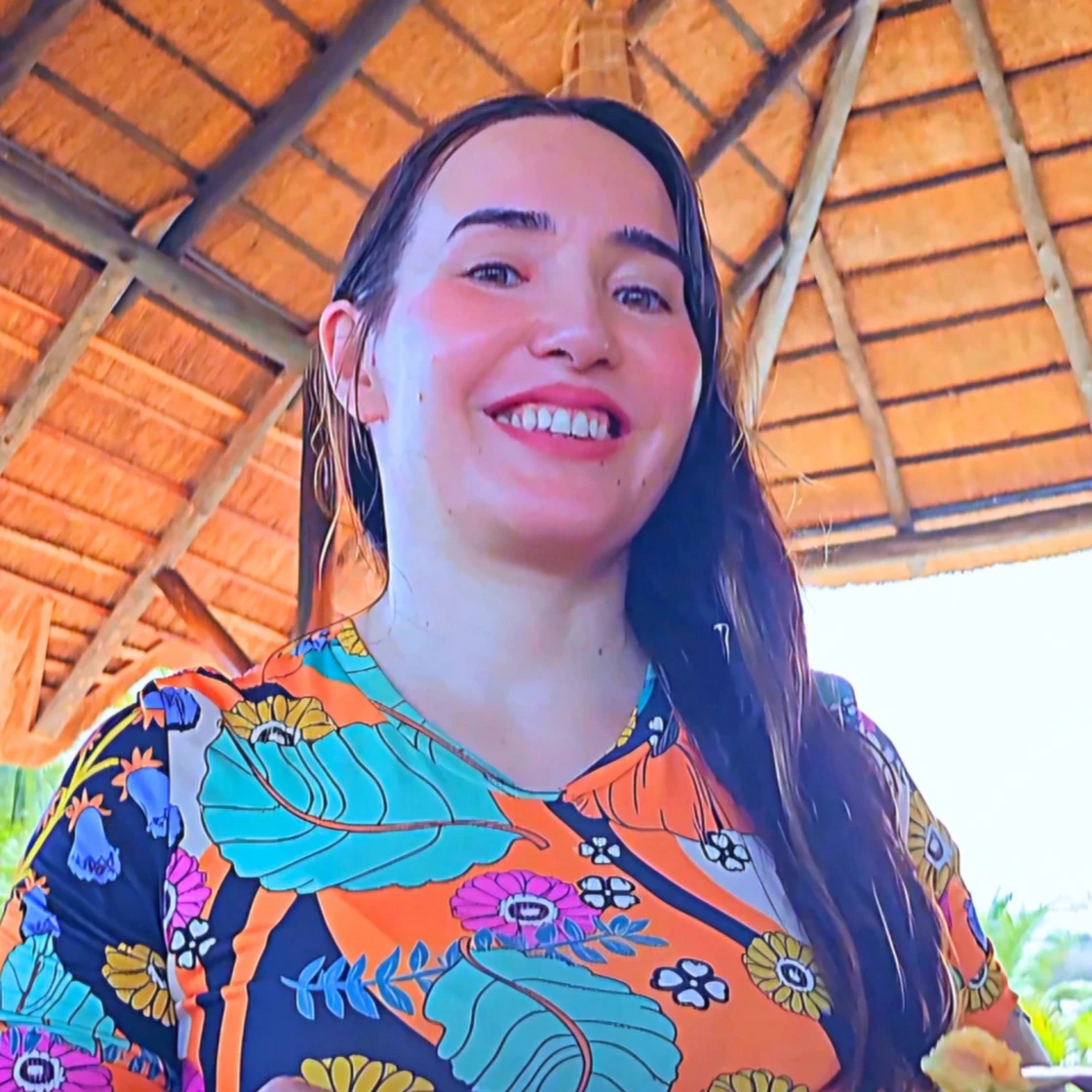
Renata Afonso Silva: Porto through the stories of those who live there
The creator of GoldenPorto talks about her childhood, her time in Luanda, literature, the old Palácio de Cristal and the challenges of turning curiosity into digital projects.
 Featured projectGoldenPorto ↗A free guide to Porto and Greater Porto.
Porto, Portugal
“I wanted people to feel that they were stepping into Porto when they opened GoldenPorto.”
Discover the story
01 · The person behind GoldenPorto
Question 01 / 25
Who is Renata Afonso Silva beyond being the creator of GoldenPorto? How would you describe yourself to someone who has never heard of you?
Who am I? I'm a person. I don't think I'm a dog. If you showed me a dog and asked, “What's that?”, I'd say, “It's a dog.” Nobody would expect me to add that it likes to sleep and has a complicated relationship with the postman. There you go. I'm a person. Now… how would I describe myself? Well… I'm optimistic and adventurous, and I'm not afraid to go against the grain if I think I'm right. I like a lot of things. I mean a lot. If I feel like trying something, I try it. Nothing but virtues so far. I have no faults. I mean, I've got loads, but that bit doesn't matter at all, ha ha!
Question 02 / 25
On Shares by Renata, you talk about the influence of your family, books, art and travel on your childhood. How much did those experiences help shape the person you are today?
My father started reading books to us while we were still in my mother's womb! He was determined to raise cultured daughters. By force if necessary, ha ha! My father is endlessly curious. He loves reading, studying, learning new things and sharing what he knows. He's a lawyer and still works, keeps up with new technology and isn't afraid to try new things. I think he inherited much of that curiosity from my grandmother, who is almost 105 and still has an extraordinarily active mind. Neither of them seems to think there's an age when you stop learning. My mother, on the other hand, is intense, creative, very playful and a born storyteller. You could write several books from her family stories alone without having to make anything up! My parents made a point of giving us every experience they could, even though we didn't always enjoy their plans as much as they did! I remember one holiday in Paris, for instance, when I must have been about ten. We spent August there, staying with friends of my parents, and it was terribly hot. All we wanted was a swimming pool. Every morning we got up, got dressed, made sandwiches, put them in our backpacks and went off to explore Paris on foot. My father led the way, guidebook in hand, telling us what had happened on that street or pointing out some detail on a building. And there we were, tired, sweaty and thoroughly fed up, following him. I didn't appreciate it much at the time. When I returned to Paris at eighteen, I was amazed at how well I knew the city. I think I ended up inheriting quite a bit from both of them. From my father, curiosity and the desire to learn. From my mother, creativity, humour and a love of storytelling. Then there's everyone else we meet and everything we experience, which also shape us throughout our lives.
Question 03 / 25
Your stories take you through places like Porto and Luanda. What did you learn from those experiences, and how did they influence your view of tourism and the identity of cities?
José, I'll answer those parts separately. Living between Porto and Luanda changed me quite a lot as a person, but I wouldn't say it particularly altered my view of tourism or the identity of cities. I was born in Porto and, of course, the city shaped me. I was lucky to grow up surrounded by good people, to meet talented and creative people and to want to learn a little from all of them. Whether I managed to is another story, ha ha! But I also have to talk about the other places I've been. I travelled quite a bit, sometimes with my ballet school, sometimes on family holidays. I met people from many cultures and, of course, all those experiences influenced me. Now, Luanda… Luanda changed me a lot. I came to Luanda because of my husband. Until then, I think I'd lived in a sort of bubble, almost in an enchanted world. In Luanda, that bubble burst. Before I go on, there's something important to say about myself that will make sense later. I've never been afraid to think differently from other people, even if it meant standing alone. I don't do it for the sake of being contrary. I simply can't believe something just because other people believe it. If it doesn't make sense to me, it doesn't make sense to me. And back to Luanda, or rather Angola… Portugal and Angola have a deeply intertwined and intense history that I won't try to sum up here, since this isn't a history lesson. But living in Angola made me realise how much of what I thought I knew about both countries was incomplete. There's also something important to mention: my family. My husband and son are shaped by several cultures. They have their own frames of reference and sometimes see things differently from the people around them. Even if they try to choose a side, they'll never belong to that side alone. And I'm in the same boat with them! But those aren't the only reasons Angola changed me. It also made me more confident about owning who I am. I've always had different ideas, but today I feel enormously at peace with who I am. For all the reasons I've just described, Angola changed me or, better yet, made parts of me that had always been there more pronounced. Today I'm perfectly comfortable with not being certain about everything, with accepting that there are things I may never know and with often finding myself in the middle of an infinite polygon.
02 · How a guide to the city began
Question 04 / 25
How did the idea for GoldenPorto come about? Had you planned the project for a long time, or did it start with a spontaneous idea?
To answer that, I have to go back a bit. When I moved to Luanda, I realised how much I missed Porto. Expat homesickness is real. These days I divide my life between Luanda and Porto, but there was a time when my entire life was in Luanda. I missed Porto terribly and wanted to do something that would bring me closer to it. I didn't quite know what yet, but the urge was there. In the meantime I created my first tourism project, LuandaGuide. It was my first attempt, so I often ran around like a headless chicken. I made mistakes, but I also learnt a great deal. The project wasn't going the way I wanted, though, and I was starting to lose motivation. That's when my husband, who also loves Porto, suggested that I use what I'd already learnt to create a guide to the city. GoldenPorto really was his idea. And it made perfect sense. Porto is my city. I know it well and I'm lucky to have people around me who know a great deal about it and still tell me stories I've never heard before. I wanted to put a little of that knowledge into a guide that would be useful to visitors and to locals who wanted to get to know their own city better. Deep down I felt I owed it to Porto. I wanted to be able to say that I'd done something for my city too, even if it was only a little project.
Question 05 / 25
Why the name GoldenPorto? Is there a particular story or meaning behind it?
I chose “Golden” because Porto is precious to me. And there are days when the name explains itself. When the sun sets on a clear day, the whole city turns golden. You can see it clearly in photographs taken in Ribeira or on the Luís I Bridge at that hour.
Question 06 / 25
What need did you feel traditional tourist guides weren't meeting?
To be honest, I never thought of GoldenPorto as a response to something missing from other tourist guides. I think I have an artist's way of thinking. When someone decides to write a book, paint a picture or stage a play, they don't necessarily start by analysing what's missing from other people's work. They start because they want to create something. That's how my projects came about. When I started GoldenPorto, I pictured it almost as an exhibition about my city. I wanted to choose the images, tell the stories, put the routes together and create an experience that would spark visitors' curiosity. Of course I wanted to help people planning to visit Porto, but I also thought about people who don't have that option. Why not show them the city from afar? I wanted people to feel that they were stepping into Porto when they opened GoldenPorto. And of course I had no shortage of stories to tell! Over the years I was lucky to meet people who knew a great deal about Porto and made me even more curious about the city. One of them was José Gomes Bandeira, a friend of my parents who was a journalist at Jornal de Notícias. He was also a film critic and a leader of the Cineclube do Porto. I particularly remember a day when he took my sisters, my parents and me for a walk through the streets of Porto. One of the stories I never forgot was the one he told us in front of the Coliseu. With his natural gift for storytelling, he described in great detail a secret space supposedly on the top floor, where it was said the mistress of a man connected with the Coliseu had lived. Of course, it may just have been a rumour from that time. José himself said many of these stories were passed on by word of mouth and that it was difficult to know exactly what had happened. True or not, the story had my full attention. I can still remember standing there listening to him. I think that's why I now walk the streets of Porto looking for other stories. Some are well documented, others have been passed down through generations, and we don't always know what actually happened. There are stories about the Count of Bolhão and episodes from the life of Camilo Castelo Branco. People even say the location of Porto City Hall may have had something to do with an old act of revenge. Truth or legend? That's exactly what I love finding out! And there are so many other stories still to discover! I also have an uncle, José Barros, who was a tour guide for Agência Abreu. I think he was one of the agency's longest-serving guides. He took us through the streets of Porto too and told us lots of stories. And of course many other people, including relatives and teachers, also awakened my curiosity. Today, in my videos and in what I write for GoldenPorto, I do a little of what those people did with me. I take the people who follow my work through the streets of Porto, telling them the stories of the places we pass. It's also my way of giving a voice to the people who gave me so much.
Question 07 / 25
How would you explain GoldenPorto to someone who had never heard of it, and what would they get from using the site?
GoldenPorto is a free guide to exploring Greater Porto. I made it out of love for my city and I want the people who use it to fall in love with Porto too. Different people get excited about different things, so I created routes for different interests. A writer might start with Literary Porto, and a couple on their honeymoon with Romantic Porto. People who would rather run along the Douro or cycle along the Gaia coast have Active Porto. And for those who love Christmas, there's a guide to exploring the city at that time of year. I want everyone to find their own Porto. If you're planning a trip, you can start with how much time you have. There are one-, two- and three-day itineraries and tips on where to eat, where to stay and how to get around. You'll find all of that on the site, with photos and videos to help you decide what you'd most like to see. If your budget doesn't stretch to hiring a guide, you can use GoldenPorto to explore the city on your own. I don't leave anyone out.
03 · Porto beyond the postcards
Question 08 / 25
Is there a little-known place you think is extraordinary but still gets less attention than it deserves?
Without a doubt, the Atlantic coast of Vila Nova de Gaia. Most tourists know Gaia for its port wine cellars and its riverside, but there's much more to discover beyond the Douro. The Gaia coast is one of those places that, to me, deserves much more attention. It has beautiful beaches, boardwalks by the sea, open landscapes, small fishing communities and a tranquillity that shows a very different side of the region. It doesn't have the same concentration of historic monuments as central Porto, but that doesn't make it any less special. Extraordinary places don't all need monuments. Sometimes the beauty of the landscape, the sea and the way a place makes you feel are enough. In fact, it was precisely the desire to show a less familiar side of Gaia that led me to dedicate one of my videos to it. Right now I'm also working on a GoldenPorto route that follows the coast from São Félix da Marinha to the point where the Atlantic meets the Douro. It'll be available on the site soon. It's a wonderful area that deserves to be explored, preferably without rushing.
Question 09 / 25
What's the biggest misconception tourists tend to have about the city?
Maybe it's less about the city and more about the people of Porto. I think one of the biggest mistakes is the tendency to generalise. There's this idea that everyone in Porto swears, everyone is very blunt and everyone loves francesinhas. Well, I'm from Porto and I don't particularly fit any of those descriptions! But the reverse happens too. People from Porto are known for being friendly, welcoming and genuine. I'm glad that's the impression many people take away from the city! But don't put us all on a pedestal, because then it only takes meeting one less friendly person to leave you disappointed. There are wonderful people here and others with difficult personalities, as there are anywhere in the world. We're individuals, not characters on a tourist postcard. So my advice is simple: come and get to know Porto, but leave the stereotypes at home. Even the nice ones!
Question 10 / 25
Tourism in Porto has grown considerably. How do you see this change, and what do you think are the biggest challenges in preserving the city's identity?
Growth and change are part of any city's life. Porto has centuries of history shaped by one change after another and by the arrival of people from many different backgrounds. Sometimes when people talk about preserving the city's identity, you'd think we'd lived in isolation for millennia, when our history shows the exact opposite. Porto has always been a place where people meet, arrive and leave, and where influences mingle. Change isn't a threat to our identity. It's part of it too. Naturally, the growth of tourism brings opportunities and challenges. It's important that Porto remain a city where people can live, work and build their futures, as well as a beautiful place to visit. The pressure on housing, for example, is a legitimate concern, although it's a much more complex problem than tourism alone. But when I think about preserving Porto's identity, I also think about who we are and the values we want to pass on: hospitality, good manners, respect for others and a willingness to do our best. And how do we preserve those values? By putting them into practice and sharing them. Imagine someone arriving in Porto for the first time and receiving a warmer welcome than they expected. The next day, perhaps they'll feel like treating someone else with the same kindness. And that way the best of what we have isn't lost. It multiplies. I believe preserving a city's identity doesn't mean trying to keep it exactly as it was in the past. It means recognising what's worth carrying forward and making sure the next generations receive it too. Because good things thrive when they're shared.
04 · Books, memories and stories still to tell
Question 11 / 25
GoldenPorto has a Literary Porto route, with references to Camilo Castelo Branco, bookshops, cafés and other writers. How did you come up with the idea of telling the city's story through literature?
Porto has a very rich connection to literature. Many writers were born in the city, lived there or passed through it, and some have life stories as interesting as the books they wrote. I have to admit those personal stories make me just as curious as their work. I've also always had the feeling that there are a lot of people in Porto who like to write. I don't know if that's particular to the city or just my impression, but I've always felt it. Then we have the bookshops, second-hand booksellers, cafés connected to the city's literary history and the Book Fair. In June 2026 we also had the first edition of BABELL, a literary and cultural festival that brought literature to Porto's streets and even to its skies, with an extraordinary drone show over the Douro. But there's another reason for this route. I'd like our writers and their stories to be much better known internationally. The whole world knows Shakespeare, but some extraordinary Portuguese writers remain relatively unknown outside the Portuguese-speaking world. A work is worth no less because it's written in a less widely spoken language. If someone visits Porto, discovers the story of Camilo Castelo Branco through GoldenPorto and feels like reading one of his books, that'll already be a small victory. At heart, that's part of GoldenPorto's philosophy too: finding what's extraordinary about what we have and sharing it with the world. I believe one of the best ways to preserve our cultural heritage is to help other people discover and appreciate it. And I'm doing my bit.
Question 12 / 25
Is there a Portuguese writer or literary work that means something special to you?
Absolutely! My favourite book of all time is O Ovário de Eva, by Clara Pinto Correia. I remember reading it on a family holiday in La Manga, Spain, in August. Picture it: the beach, the sun, the heat, everyone enjoying their holiday… and there I was, completely fascinated by a book about the history of scientific theories of reproduction! I couldn't keep what I was discovering to myself. Every day I'd pester my family, telling them about the extraordinary things I was reading. Needless to say, after a while nobody wanted to put up with me any more! What fascinated me most was finding out how scientists in earlier centuries imagined human reproduction worked, and how seriously they took some theories that seem so strange to us today. Above all, though, the book sparked a curiosity I still have today. How will future scientists look at what we think is true today? Which of our ideas will seem completely absurd to them? Science has always fascinated me. If I had to choose what to study today, I might go down that route. I think that's why O Ovário de Eva made such an impression on me. It left me fascinated by what scientists used to think and curious about what we'll discover next.
Question 13 / 25
In one of your pieces you explore a family memory of the old Palácio de Cristal, told by someone aged 104. How did that story come about, and how did you feel about working with such a personal memory?
The story came from my grandmother, who is almost 105 and has an extraordinary memory. I have a video of her describing the old Palácio de Cristal and recalling when she used to go dancing there. I think it's wonderful to hear these stories from someone who was there, who knew the place and who holds memories of a Porto that no longer exists. But my grandmother isn't the only one saddened by the destruction of the Palácio de Cristal. I think the loss left its mark on several generations of people from Porto. I grew up hearing about it myself. I distinctly remember my history teacher saying that demolishing the Palácio de Cristal was one of the greatest crimes committed against the city's heritage. When you learn the history of the building, you understand why. It opened in 1865. It was a magnificent iron-and-glass structure inspired by London's Crystal Palace and hosted a major international exhibition. Imagine what that meant for Porto in those days! Here was a city showing its ambition, its modernity and its desire to be part of the world. And there's someone in this story who also deserves to be remembered: the physician António Ferreira Braga, one of the driving forces behind the project. He put his personal fortune into building the palace and ended up practically destitute. It's a sad story, especially when you think of what he sacrificed to leave the city something so extraordinary. The palace also had a monumental organ, considered one of the largest of its time, which eventually disappeared too. According to stories that have long circulated among people in Porto, there were financial interests behind the demolition, particularly in selling the materials. I don't know if that's true, but I do know that destroying the palace in 1951 left the city deeply saddened. A sports pavilion was built in its place. And that's exactly where my grandmother comes in. Buildings disappear and photographs remain, but there's one thing no photograph can convey: what people experienced in those places. My grandmother tells me more than what a beautiful building it was. She tells me about a place where she was happy, where she went dancing, about moments that were part of her youth. That's what I don't want us to lose. One day there'll be no one left who knew the real Palácio de Cristal, but we can go on listening to and sharing the memories of people who were there. And there's a curious thing: it's been over 70 years since the demolition and we still call the place Palácio de Cristal. The building disappeared, but the name stayed. I think that says a lot about what the palace meant to Porto.
05 · Creating content and working independently
Question 14 / 25
When you make a video, is your first priority to tell a story, show the beauty of a place or share practical information? How do you strike that balance?
I want all of that! I want to tell stories, show beautiful places, share interesting facts, give useful information and every now and then show a little of my life in the city too. Above all, I want to draw people in, because I'd love them to fall in love with Porto. I've always loved watching travel videos, and I realised the ones I liked most were the ones that had a bit of everything. They made me feel as if I was travelling with those people, discovering new places and having fun with them. In fact, my husband used to laugh his head off at me because there was a couple's travel channel I loved following. While I watched their videos, I'd catch myself talking to them and laughing at their adventures as if I were there! I think in my head we were all already on the same trip. That's exactly the feeling I try to create in my videos. I want people to come walking around Porto with me, discover stories, enjoy the scenery, get a sense of life in the city and have fun along the way. Do I manage it? That's another story! I still have a great deal to learn and improve, but that's my aim: for whoever's on the other side of the screen to feel, for a few moments, that they're there with me enjoying Porto.
Question 15 / 25
What's the most demanding part of working as an independent creator: finding stories, researching, filming, editing, keeping the site up to date or reaching an audience?
I think the hardest part of working independently is loneliness. Earlier I said I've never been afraid to stand alone with my ideas. And that's true. But this is a completely different kind of loneliness. It's more than doing the work alone. It's also learning, looking for solutions, making decisions and, above all, staying motivated. You have to find motivation every day, even when everything goes wrong, when you're tired or when you start to doubt yourself. And on top of finding that motivation within myself, I feel I have to show confidence to the people around me, so they'll keep believing in me and in what I'm building. And I don't always feel that confident! I have doubts, worries and days when nothing seems to move forward too. But the work can't depend solely on the days I feel confident. Another difficulty is finding a community of people who genuinely understand what I do. People I can swap ideas with, share difficulties with, learn from and even vent to when something goes wrong. They aren't always easy to find. So for me the most demanding part isn't researching, filming, editing or developing a website. That's all a great deal of work, but I like doing those things. The hard part is finding the strength to keep going every day, even when things go wrong, without always having someone beside me who genuinely understands what I'm going through.
Question 16 / 25
Shares by Renata shows a more personal side of your work. What stories or ideas feel at home there but wouldn't necessarily fit GoldenPorto?
Shares by Renata started precisely because I wanted a space where I could share whatever I felt like, without being limited to one subject or place. GoldenPorto is dedicated to Porto and the surrounding region, and LuandaGuide is dedicated to Luanda, but Shares by Renata is different. There I don't have to worry about whether a piece fits a particular theme. That gives me an enormous amount of freedom! Of course I still enjoy travelling, discovering places and telling stories, so those interests feature prominently. But I can also talk about other things that make me curious, share personal experiences or simply explore an idea that's come to me. And because I also love creating websites, I use sharesbyrenata.com to show that side of my work and the services I provide to other people and businesses. At heart, the name itself explains the project: Shares by Renata. It's the things I share, my interests and whatever I feel like making or showing at any given moment. It's the only project where I don't have to ask myself, “Does this belong here?” If I feel like sharing it, it belongs!
06 · Collaborations and sustainability
Question 17 / 25
GoldenPorto lets hotels, restaurants, cultural venues and local businesses send in suggestions or proposals for collaboration. What do you look for in a potential partner?
I'm open to suggestions and proposals for collaboration, of course! I like the idea of discovering projects and experiences I may not know about yet. But there's one essential condition. It has to be something I genuinely think is good and want to recommend. I don't mind whether it's a well-known hotel, a small family-run restaurant, a local artist or an experience that hasn't had much publicity. What matters is the quality and what it can add to a visit for someone discovering Porto. Naturally, people have different tastes and I can't guarantee everyone will like the same things. But I can guarantee I wouldn't recommend something just because there's a business opportunity. I want people to trust GoldenPorto and know that when they find a recommendation from me, it's because I believe that place or experience is worth discovering.
Question 18 / 25
Do you intend to keep GoldenPorto primarily as a free editorial guide, or can you see yourself developing extra services, tailored experiences or other sources of income?
I want GoldenPorto to remain a free guide that everyone can use. That's something I'd like to keep. Of course I'd also like the project to bring in revenue. Creating content, producing videos, visiting places and keeping a website running all cost money and take a great deal of work. The more I can invest in GoldenPorto, the more I can develop and improve it. I don't know exactly what the best way forward will be yet. I'm open to partnerships and other opportunities that may come up, provided they make sense for the project and for the people who use it. Ideally GoldenPorto would become financially sustainable while remaining free for visitors.
Question 19 / 25
As an independent project, how do you measure its success? By website visits, people's comments, discovering new places or other results?
For me, success has several dimensions. Of course I like seeing website visits grow and reaching more people through my videos. It would be strange to say the numbers don't matter to me! But there's a special satisfaction when someone emails me or leaves a comment saying my work helped them, they discovered something new or they're really enjoying what I do. At those moments I feel all the effort was worth it. And, of course, I'd also like to make a living from my projects. Financial success matters if I'm to keep doing what I enjoy. So for me success would be bringing three things together: reaching more and more people, making something they value and turning my projects into a sustainable career.
Question 20 / 25
What advice would you give to someone who wants to start their own digital project but doesn't know where to begin or worries they won't be able to make their idea a reality?
My advice is simple: get started! I've always thought that if we really want to do something, we ought at least to try. We don't have to know everything or have the whole project worked out. Often we only discover what we want to do once we start doing it. And of course we'll make mistakes! Sometimes even in public, which isn't exactly pleasant. But it's important to go easy on ourselves. Did we make a mistake? Did we learn anything? Great, next time we'll try to do better. We can learn a lot from courses and training, but there are things only experience can teach us. One of the most interesting is how one idea leads to another. We start developing one, another appears, we experiment and change direction, and little by little what we want to create takes shape. So don't wait for the day you think you know everything, because that day probably won't come. And above all, try to have fun! There are few things as rewarding as having an idea, getting to work on it and one day looking at what you've built and thinking: I made this!
07 · What lies ahead
Question 21 / 25
GoldenPorto's planned routes cover subjects such as street art, football culture, historic cafés and trams. Which one are you most keen to develop?
All those routes matter to me and I want to develop them. But if I had to give one priority, it would be Porto's football culture. One of the ideas behind GoldenPorto is that everyone can discover the city through their own interests. Knowing how passionate so many people are about football, how could I leave out such an important part of life in Porto? And I say that even though I don't know much about football! But there's one thing I understand perfectly: the emotion the sport brings out in people. When FC Porto won the national championship in May 2026, I was a long way from Portugal, but I watched footage of the huge celebration in Porto. It was extraordinary to see so many people in the streets and all that joy! I have to admit it was one of those moments when I missed my city terribly. I would have loved to be there! So when I develop this route, I want to talk about more than clubs, stadiums and titles. I also want to tell people's stories and show what football means in the life of the city.
Question 22 / 25
Would you like to expand GoldenPorto into new experiences, other regions of Portugal or international audiences? Or would you rather go deeper into Porto?
GoldenPorto will remain dedicated to Porto and Greater Porto. At most, it might extend into the Douro region because it has such strong ties to the city. But I want it to keep that identity and become an increasingly comprehensive guide to this area. That doesn't stop me from creating other projects about different places. I have Shares by Renata, where I can share experiences and stories without being limited to one region. And if I feel like creating a broader platform one day, why not? I haven't planned it, but I don't want to close off the possibility either.
Question 23 / 25
Is there a major project, collaboration or professional dream you'd like to make happen over the next few years?
Yes! I'd love to travel the world and see a great many places. If I could make a living doing it as well, even better! But I suppose that's a lot of people's dream, isn't it? We only get one life and I want to make the most of it. I don't want to get to a certain age, look back and think, what a dull life I had!
08 · A message from someone who loves Porto
Question 24 / 25
If you could choose just one place in Porto to keep going back to, however many times you'd already been there, which would it be and why?
I'm going to cheat a little, because my favourite place isn't exactly in Porto. It's in Vila Nova de Gaia! It's the beaches in Gaia. There's nowhere in the world where I feel better. I grew up in that area and have so many memories tied to those beaches that I couldn't even pick just one. However often I go, I never get tired of them. I don't think I ever will.
Question 25 / 25
What would you like to say to Montarion Live's international readers who don't yet know Porto, GoldenPorto or the person behind the project?
Come and get to know Porto! And don't stick to the best-known places. Set aside some time to explore Greater Porto too, because there's so much more to see and experience than what you find on the postcards. And above all, get to know the people! Take a chance, strike up a conversation with a stranger, make friends. If an experience doesn't go well, don't be discouraged. Keep trying! We can visit the most extraordinary places in the world, but it's often the people we meet along the way who make a trip truly unforgettable. As for GoldenPorto, the doors are open! Come in, explore, find your own Porto and have fun. Even if you can't visit the city, come along anyway! We can travel through stories, photographs and videos too. And don't think you've seen it all! GoldenPorto is still growing. I've got loads of ideas I plan to make happen, and I think some will surprise you. So keep visiting the site and following my videos on YouTube. I've still got plenty to show you and a few surprises I'm keeping to myself for now! And as for the person behind the project, I think after all those questions you've got to know me quite well! Maybe even better than some of the people who know me in person!